Why Wind Changes a Cricket Ball’s Flight
Why wind changes a cricket ball’s flight: learn how crosswinds and headwinds shape movement, and how bowlers, batters and fielders can read the air.

A crosswind can push a lofted cricket ball towards the boundary while a headwind can make a driven shot hang longer than the batter expects. Why wind changes a cricket ball’s flight is not just a question of direction: the ball’s speed, height and spin all affect how much the moving air can influence its path.
Air acts on the ball throughout its flight
A cricket ball does not travel through still air. Wind is air moving across the ground, so a ball travelling through it experiences a different airflow depending on its direction. The effect is often easiest to see on a high catch or a long hit, because the ball remains exposed to the wind for longer than a fast delivery close to the ground.
Think of the ball’s movement relative to the air, not just relative to the pitch. If it travels in the same direction as the wind, the airflow around it differs from the airflow it meets when travelling into the wind. That changes the aerodynamic forces acting on the ball, including drag, which resists motion, and any sideways or vertical force produced by spin and surface airflow.
The wind does not simply carry every ball in its own direction. A hard-hit ball has considerable forward speed, and a gust is only one influence on its path. But as the ball slows, rises or turns, the wind may become more noticeable, particularly when the shot or delivery is already travelling across the breeze.
A crosswind changes the sideways line
A crosswind blows across the line between bowler and batter. It can shift the apparent line of a delivery, drift a spinning ball, or carry a lofted shot away from its initial direction. The size and direction of the change vary with the ball’s speed, height, spin and the steadiness of the breeze.
For a bowler, a crosswind can make an intended line harder to judge. A ball sent into the breeze may lose speed differently from one moving with it, while a spinner can see the wind interact with the ball’s rotation. The bowler still has to land the ball on the intended area; the air is an added influence, not a substitute for control.
Batters also need to distinguish drift from turn. Drift is movement through the air before the ball pitches; turn is movement after it hits the surface. A ball can drift towards the batter and then turn away, or appear to hold its line in the air before gripping the pitch. Watching the release and flight helps the batter avoid treating every sideways movement as spin off the surface.
Headwinds and tailwinds alter time in the air
A headwind blows towards the oncoming ball. It can increase the resistance the ball meets and make a lofted hit travel more slowly through the air. The result may be a longer-looking hang time, giving fielders more opportunity to get underneath the ball, though the exact flight depends on the shot and the wind’s strength and consistency.
A tailwind blows in the direction the ball is travelling. It may reduce the relative airflow opposing the ball, but it does not automatically make every shot carry farther. Launch angle, contact quality, spin and the wind’s height profile still matter. A low, hard drive may show little obvious change, while a high hit can reveal the breeze more clearly.
For bowlers, a headwind or tailwind can change how a delivery arrives and how much effort feels necessary to maintain pace. Batters may notice that a ball struck into a headwind seems to stall, or that a ball played with a tailwind keeps travelling after it has passed the fielders. Treat those impressions as clues to the conditions, not fixed rules for every delivery.
What should each player watch in the air?
How can a bowler judge a crosswind?
Look at visible clues before the over, such as a flag, a windsock or the movement of loose grass, then compare them with the ball’s flight. Keep an eye on whether the breeze is steady or gusting; a gust can affect one delivery differently from the next.
Why does a high catch move late?
A ball can seem to settle and then shift as it loses speed near the top of its flight. The wind may be stronger above ground level, or a gust may arrive while the ball is aloft, so fielders should keep adjusting their position rather than fixing their feet too early.
How should a batter read wind-driven drift?
Track the ball from the bowler’s hand and note its line before it pitches. Comparing that flight with the pitch movement helps separate air drift from turn, and makes it easier to decide whether to play late, leave or move across the crease.
Coastal gusts make observation part of the game
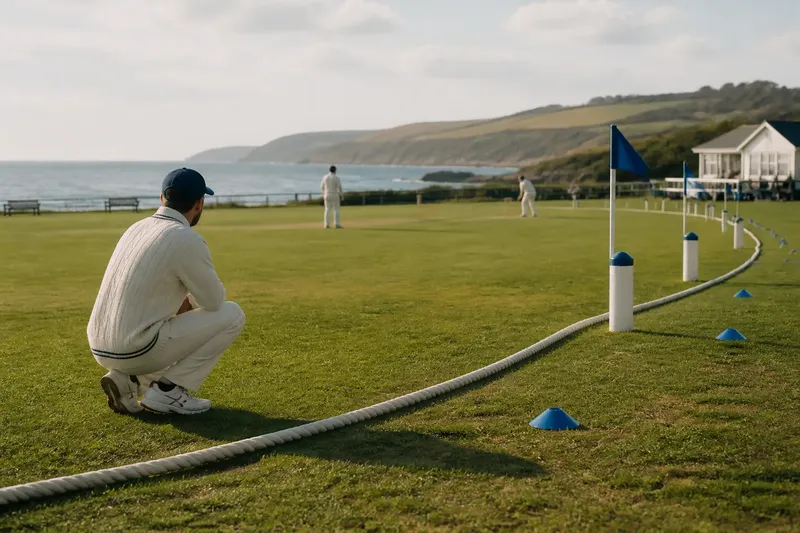
At a seaside ground, wind can change direction around stands, trees, sight screens and buildings. The breeze at the boundary may not match the air over the pitch, and a gust funnelled between structures can arrive unevenly. A player’s sense of wind on the face is useful, but it may not describe the conditions where the ball is travelling.
Say a batter notices a crosswind pushing a practice loft towards the leg-side boundary. In an invented situation, they ask a teammate at long-on to watch the next few warm-up hits and compare the ball’s landing line with its launch line. If the drift remains consistent, the batter can account for it when choosing a safer direction; if it changes between hits, they should avoid assuming the wind will provide reliable assistance.
Fielders can make the same sort of observation by watching warm-up throws and catches from their usual positions. Notice whether the ball bends sideways, drops sooner than expected or carries beyond the target. These are practical signs of how the air is affecting play at that particular height and angle.
Use the wind as information, not a prediction
Wind reading is most useful when it informs a decision without replacing attention to the ball. A bowler can consider whether to alter the line or length; a batter can judge whether a high shot carries extra risk; a fielder can shade a position towards the likely drift. Each adjustment should remain responsive to the next ball, because a breeze can shift and the delivery can behave differently.
When conditions or local playing rules affect safe positioning, follow the organiser’s guidance and the ground’s instructions. For ordinary play, the simplest habit is to look up before the ball is bowled, note the breeze at your position, and then watch the ball’s actual flight. Understanding why wind changes a cricket ball’s flight begins with that comparison: what the air suggests, and what the ball does.